Project Presentation
OxyNotte Project: Integrated Monitoring and Screening System
The Silent Enemy: What Sleep Apnea Really Is and Why We Can No Longer Ignore It
Imagine holding your breath for thirty seconds, then for a whole minute. Now imagine doing that while sleeping, without even realizing it, dozens of times every single hour. This is the reality of Obstructive Sleep Apnea Syndrome (OSAS).
According to estimates by the World Health Organization (WHO), nearly one billion people worldwide suffer from sleep-related breathing disorders, and the vast majority of them are completely unaware of it. Most people assume they simply “snore a bit too much” or blame frequent night awakenings on daily stress, ignoring a far more alarming clinical and epidemiological reality.
When the airway collapses during sleep, oxygen stops reaching the lungs and, consequently, the brain. This condition is called hypoxia (oxygen deprivation). To survive this suffocation, the brain is forced to trigger an adrenaline rush, provoking a “micro-arousal” that restarts breathing, often accompanied by a gasp or a loud snort.
The health risks are devastating:
-
Cardiovascular Complications: Instead of resting, the heart is subjected to immense stress. Spending years in this state dramatically increases the risk of drug-resistant hypertension, heart attacks, and strokes.
-
Metabolism and Cognition: Metabolic alterations such as diabetes occur, alongside long-term cognitive decline.
-
Daytime Impact: The lack of deep, restorative sleep translates into chronic fatigue, poor concentration, and the infamous, potentially fatal, micro-sleeps while driving.
Critical Issues in Traditional Screening
If sleep apnea is so dangerous, why isn’t it diagnosed earlier? Because traditional screening often requires staying overnight in a specialized clinical facility, hooked up to dozens of wires, facing endless waiting lists and high costs. Furthermore, sleeping in an unfamiliar bed attached to numerous cables alters sleep quality to the point of risking flawed data.
A solution is needed to monitor large segments of the population in the comfort of their own homes, in their own beds, for multiple nights. This is where the Telmetry OxyNotte infrastructure comes into play.
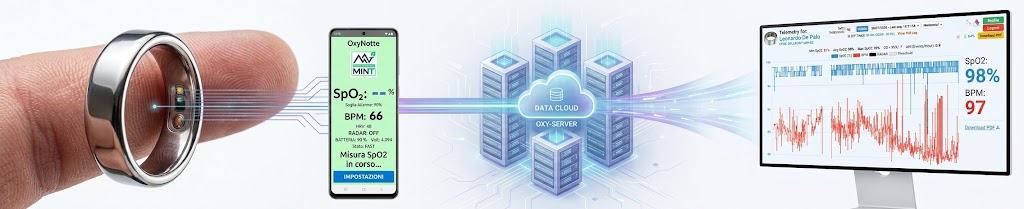
OxyNotte Technology: Turning a Smartphone into a Lifesaving “Holter”
To continuously record a person’s vital parameters (Oxygen Saturation and Heart Rate), a non-invasive wearable device is required, such as a Smart Ring. However, the ring alone is not enough: it must transmit these data points in real time.
“Fashion Phones” vs. Android “Workhorses”
We are used to thinking that an expensive smartphone—perhaps the latest flagship model costing over a thousand euros—is the best choice for everything. Not for telemetry. These “fashion phones” are designed to look sleek, run fast, and maximize battery life. To achieve this, their operating system acts aggressively: as soon as the screen is locked, it forcefully kills or freezes any background applications.
But we are not taking a selfie; we are monitoring a breath.
This is why the OxyNotte system was specifically engineered on the Android ecosystem. The software we built bypasses these power-saving restrictions, instructing the phone’s CPU: “Stay awake, we are recording vital data”.
A Daily Habit Turned into a Prevention Tool
At night, by established habit, almost everyone places their smartphone on the nightstand to charge, just inches from the bed. This daily routine creates the perfect operational scenario: the phone is continuously powered, physically close to the ring, and fully ready to acquire and process real-time data for hours without the risk of shutting down.
This means that even an affordable Android phone, resting on a nightstand while charging, turns into a powerful Holter recorder, operating continuously throughout the night.
Local Alarm System: Preventing Severe Hypoxia
What happens if the user’s blood oxygen level (SpO2) starts dropping dangerously during a respiratory event? The OxyNotte app does not passively stand by and log the event.
Thanks to fully customizable thresholds, if oxygen saturation drops below acceptable limits (reaching 50% or 40% in extreme cases), the smartphone transforms into an active emergency system: it immediately turns on the display and sounds an unmistakable acoustic alarm.
The logic is as simple as it is vital: it is infinitely better to be abruptly awakened in the middle of the night by an alarm than to remain asleep in a state of severe hypoxia, with the heart struggling to pump and the brain facing a critical oxygen deficit. The alarm breaks the apnea episode, prompting the user to move, change position, and resume normal breathing.